ANY INSIGHTS YET?
SEASON 3 | EPISODE 10
What Brands Can Learn from Disengaged Teens with Rebecca Winthrop, Senior Fellow at The Brookings Institution
Episode Description:
This episode is a little different.
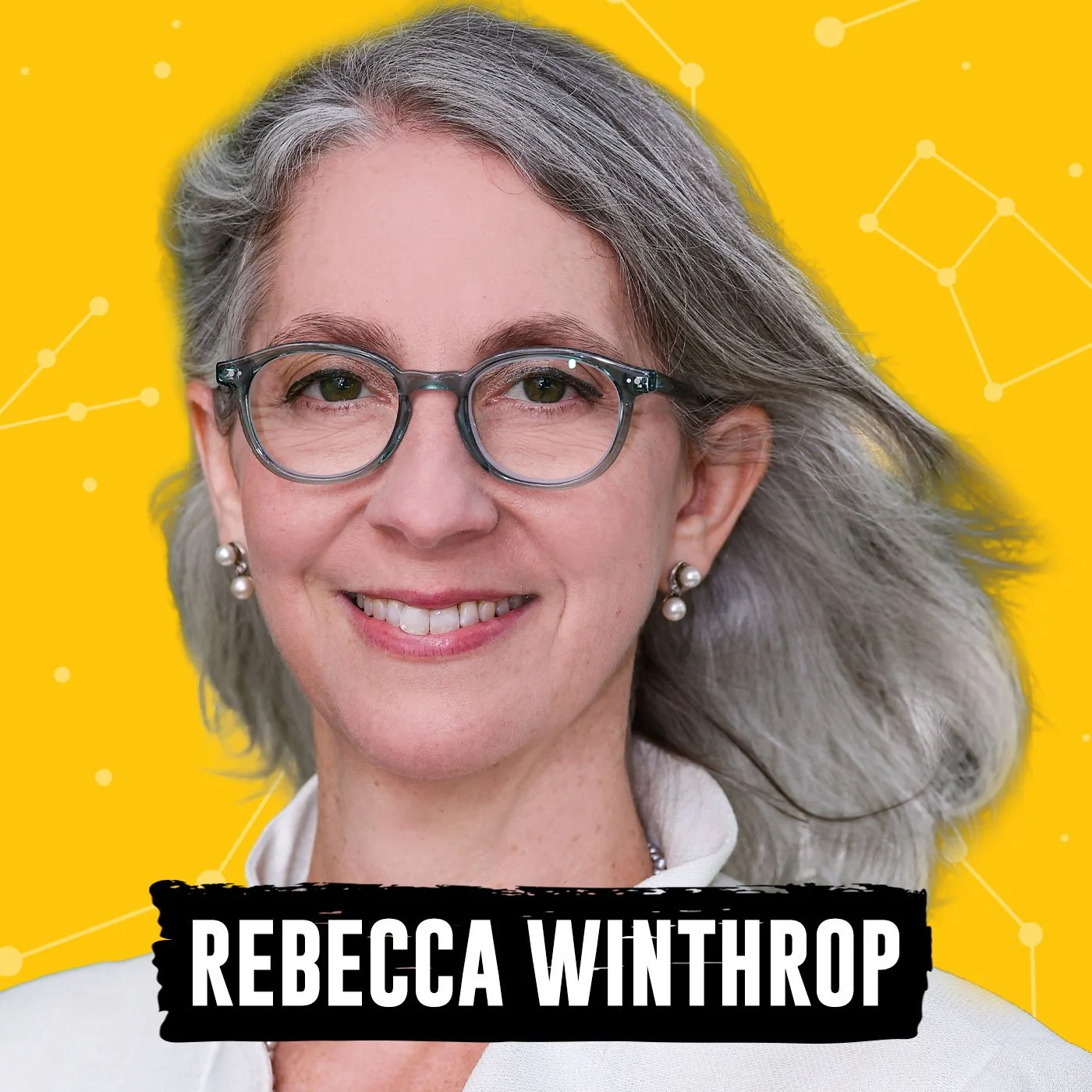
Instead of talking with a Chief Creative Officer or a Chief Strategy Officer about a recent ad campaign, I sit down with Rebecca Winthrop, senior fellow at The Brookings Institution and co-author of The Disengaged Teen.
Together, we dive into the insights that emerged from her research with over 60,000 students, 25,000 teachers, and 6,000 parents, and we explore what it takes to really engage young people in today’s tech-driven world.
Rebecca’s findings around engagement are fascinating and we talk about different modes of learning (passenger mode vs. resistor mode vs. explorer mode) and the surprising overlaps between the world of branding and the world of education.
In both worlds, you’re dealing with a rich combination of attention, inertia, distraction, and indifference. And in both cases, real engagement only happens when the people you’re talking to connect the experience you’ve created to something meaningful in their own lives.
Some of my favorite aha moments from our conversation include:
What kids are neurobiologically primed to do in adolescence and the implications for designing more engaging experiences
The Mattel-OpenAI partnership and why Rebecca is both excited and concerned about its implications
How repetition and nagging can often shut down executive function in teens (and how brands might accidentally be doing the same thing with their messaging)
What Minecraft can teach us about learning, rewards, motivation, and flow
How working for the Fish and Wildlife Department in her 20s led Rebecca to some valuable life lessons about FIO (Figure It Out) jobs
Why educational innovation starts with rethinking how we measure progress and what that also means for brand strategy


-
Rebecca Winthrop: [00:00:00] We have evolved from millennia and young people everywhere in the world are born with these fonts of creativity. And that is sort of the human genius, and we collaborate and we use tools. Yes, we do use tools. AI is a new tool, but is it so powerful that it will be too intrusive, that it erodes the core of who we are as humans?
Chris Kocek: Welcome to any insights yet the podcast that explores the intersection of strategy, inspiration, and branding. I'm Chris Kocek. Now, if you've been listening to the show for a while, you know that many of my guests are creative directors, strategists, and entrepreneurs, but every season I like to save space for one or two wild card interviews, conversations with people outside of the industry who have something valuable to say about how we think, how we behave, and how we engage with the world around us.
In season two, I interviewed Alina Burroughs, a forensic science expert from the hit show Crime Scene, confidential, because I wanted to [00:01:00] explore the overlaps between marketing and murder. Earlier this year in season three, I spoke with Assaf Eshet from Clixoo Toys because I wanted to connect the dots between toy design, the power of play, and creativity.
And now to finish off season three, I have another wild card guest, Rebecca Winthrop. She's a senior fellow at the Brookings Institution and a co-author of the Disengaged Teen, a book that explores why so many high school students are tuning out and what it actually takes to get them reengaged. I first heard Rebecca on the Ezra Klein podcast back in May where they talked about the need to rethink the purpose of education, and I was so intrigued by her research around engagement that I reached out to her to see if she would join me on any insights yet.
It may seem like a strange pairing, advertising and education, but to me, Rebecca's work isn't just about education. It's about attention. And curiosity. and the challenges teachers face in the classroom are [00:02:00] many of the same challenges we face in branding. We cover a lot of ground in this interview, including classroom design, what we can learn from Minecraft, and the recently announced Mattel-Open AI partnership that has Rebecca excited and concerned about where that might lead.
But to get things started, I asked Rebecca if there was one data point or key finding that came out of her research that really surprised her.
(Sound Effect)
Chris Kocek: You did a global study on education and learning that included over a hundred in-depth interviews and a survey of 65,000 students. Was there a particular data point or an observation that someone made during those interviews that made you go, wow, that's interesting?
Rebecca Winthrop: One of the sort of takeaways I would say that I was not expecting was how much kids, quote unquote, the problem children, we call them kids really stuck in resistor mode - how much they got going for them. Actually, they have a [00:03:00] lot of agency and actually they can just get the right conditions around them so often they turn around really quickly and end up being incredible.
Chris Kocek: Mmmm What are some of the things they have going for them that stood out to you?
Rebecca Winthrop: So kids often get labeled the problem. Children, when they disrupt class. Class clown, don't listen to the teacher. Take long bathroom breaks, don't do the assignments speak up, disrupt, skip class, don't show up at school. And so these aren't things that we families nor educators love.
However, these kids have a fair bit of gumption and chutzpah because whatever it is that isn't working in the classroom school environment, they are making it known that it isn't working for them. They don't necessarily have the language 'cause they're kids and kids don't necessarily have articulate paragraphs about what is not working in this context for me.[00:04:00]
But they're giving you the behavioral signs, sometimes the verbal signs, and it can be inappropriate. And you, you want to make sure kids have behavior modeling and expectations for how to treat other people. But you know, they're not passive kids. They're not passengering, coasting through life being really compliant and apathetic and they actually have a fair bit of agency.
It's just pointed away from their learning. So that's what they have. And if you can point it towards their learning and give them a little boost, they often take off.
Chris Kocek: Well, to connect it back to branding for a second, I feel like disruptors in the classroom can potentially become big disruptors in the branding space, right?
Rebecca Winthrop: absolutely,
Chris Kocek: They see what's not working. They see what's ridiculous. They poke fun at it. They come up with a whole new brand or innovation or messaging style that gets people's attention. So it doesn't work well in school though.
Rebecca Winthrop: Right. The classic Steve Jobs, et cetera. The [00:05:00] resistor mode kids. Kids who are sort of resisting what is traditionally asked of young people often are super creative and are really energetic and interested in the world and and feel confined by the traditional model of schooling. We've had one young man who's a character in our book, the Disengaged Teen, called Kevin, and he described it as being in an airtight container with no oxygen.
That's how he felt. He was really classic resistor mode kid. But then actually when he got to a different type of school model that gave him a lot more agency, he took off and he was like, I finally felt like I could breathe. There was air.
Chris Kocek: Mm-hmm. Well, there's this tension in society, right, where you've got students who are told on a daily basis, you're unique, you're special, you know, all of these kinds of things.
And then school. And I hope, I'm not making any enemies when I say this, but school often is about [00:06:00] conformity, conform to this model, to what we say to do and how to do it. And there are plenty of kids who are just like, what happened to me being special and doing things in a different and unique way. Were there any other surprising things that you uncovered about how teens actually learn or learn in the best possible way?
Rebecca Winthrop: This is a personal one, because I had to reform my parenting strategies. I have two boys. I was surprised by the brain research around nagging, parental nagging, which I have been known to do, and there was this incredible study that really made me think, oh my gosh, where they did brain scans of kids.
Listening to different scripts of their mothers saying things. And one script was their mom nagging them, [00:07:00] saying one thing that bothers me about you and then they would talk about whatever it was that was normal for them. And in every case, when kids heard that nagging piece, the problem solving part of their brain shut down.
So really when we nag our kids to do things, you know, for example, I was really busy nagging my middle school son to do his homework when he came home, did you do your homework? Have you done your homework? When are you gonna do your homework? What? What do you have? Homework? What's going on? And he would procrastinate and procrastinate.
And we found this actually to be very common, sort of parents stuck with their kids in this procrastination nagging loop from hell. And I realized, oh, I'm making it worse. I'm not helping because every time I nag, I'm taking away actually his autonomy. His ability to make a plan and to act and shutting down the problem solving part of his brain.
So I've had to change my ways.
Chris Kocek: Yeah, that hovering aspect. We want the best for our kids. We also don't want them to stay up until some [00:08:00] super late hour being like, oh, I just remembered I need to do this thing so we tell them again and again. But really every time we do that, we're not letting them develop that little voice inside their own head to do it and get it done.
Is that what I'm hearing you say?
Rebecca Winthrop: Yes. You know, parents nag out of love of their kids 'cause they care. If they didn't care, they wouldn't nag. And we talk about this in the book and we talk about what you do instead, which is. Do you have homework? Yeah. Yeah. What's your plan for doing it? Because we have dinner at six and you're gonna go to bed at 10, lights out, like that's it.
And if you decide at 9:45 to start, you're still going to bed at 10.
Chris Kocek: Natural consequences.
Rebecca Winthrop: Better luck next time. Try it again.
Chris Kocek: Yeah, well it helps 'em develop that executive function so that they can start to map out their day and make their plans and things like that.
Rebecca Winthrop: They feel like a little more agents of their own lives.
Chris Kocek: Well, here are some data points that jumped out at me from your book. The Disengaged Teen. In third grade, 75% of children say they [00:09:00] love school, but by 10th grade, just 25% say that. Why do you think that is? What are the top three things that contribute to that disturbing slide between third grade and 10th grade?
Rebecca Winthrop: I actually think of all the data we have in our book, which is a lot. That to me is the saddest data point we have because kids love learning. They're born to love learning. They love seeing their friends and being around other kids and other people and being exposed to ideas and being involved in their communities.
So it's not the kids that are the problem, it is our educational structure. And it has a lot to do with, as kids get older, they enter, you know, adolescensce, early adolescensce in particular. So it really drops off when kids enter middle school and just sort of takes a nosedive throughout high school. And that's in large part because what kids are evolutionarily neurobiologically, primed to do [00:10:00] is to get out and explore and make connections with the world and find their tribe and figure out how to contribute to it and figure out how the world works. And a lot of times the structure of school doesn't let them do that. It becomes more subject discipline and narrow and siloed.
So you go from one teacher to many teachers, it offers more freedom, but doesn't necessarily offer the commensurate amount of freedom that kids would need when they enter adolescence. And the learning and instruction often becomes much more focused on academics because the traditional goals have been prepare kids for a higher education, which makes sense, but you can focus on academics and connect what they're learning academically to what's relevant in the real world and what kids would do. With their knowledge and knowhow and skills. And that's the piece that is often missing.
Chris Kocek: I have a book that I read to my kids when they were little called, If I Built a School by Chris [00:11:00] Van Dusen.
It's a story of, you know, the, the way the rhyme scheme goes. It’s like, you know, if I built a school, I would have a cafeteria that looked like this and I would have a rocket ship. You know, it's, it's, it's quite fantastical. But it provokes that question, which I've actually brought back to my kids over the years, which is like, what does your perfect day look like?
Assuming that we all have to learn something because we all have to contribute something to the world to some degree, right? That we can't just do nothing all day and eat sweets, but like assuming certain things, what would your ideal day look like? What would be the spacing of different activities and how much downtime would you give yourself between periods of learning and things like that?
And so I try to bring that back to them. But it all, it all started with that book. If I built a school,
Rebecca Winthrop: I love that.
Chris Kocek: Do you feel like there's a difference between loving school and loving learning?
Rebecca Winthrop: I think that they can sometimes be the same, but often they're not. We know when COVID kids really missed school, it was terrible that they [00:12:00] couldn't go to school, and what they missed were their friends.
It's not actually that kids don't like school, they don't like what they do in school is what we found from the qualitative research. So there's plenty of kids who happy to see their friends but don't really like the work of school, what they're doing in school, but are learning like crazy and love learning things outside of school.
We found that a lot. Uh, learning how to skateboard and do a flip and a trick that that is intensive learning, watching YouTube videos over and over, trying it again and again, getting feedback from their friends out on the skate park or learning to bake or even academic stuff, learning robotics, like there's all types of things that kids love to learn who are not loving what they do in school, not loving the content of their lessons in school.
Chris Kocek: So the format makes a big difference.
Rebecca Winthrop: Yeah, just 'cause a kid doesn't like school doesn't mean they don't love learning is I guess what I'm trying to say. And in fact, every kid is a good learner. They're just [00:13:00] not necessarily a good learner in the way we want them to be.
Chris Kocek: Yes. My son loves Minecraft. He loves Minecraft videos and watching other people create things, and then he creates things and I can't play Minecraft to save my life. I usually fall into oceans and I get attacked by zombies.
Rebecca Winthrop: Got a Minecraft lover in our household too. And they're learning a ton actually. They're like, strategy, oh, I've gotta get this and I've gotta amass that and I need more food. Or, you know, there's a lot of strategic thinking, and the reason I like Minecraft so much is it's open-ended.
You can create whatever you want. You're not in a very narrow structure. So it's super creative, but lots of strategic thinking, oh, I gotta run faster. Oh, it's getting dark. Oh, I wanna build a teleport. I need X, Y, and z. I might, maybe I should collaborate with the villagers, whatever.
Chris Kocek: Oh yeah. I mean, I tell 'em, I say, look, you've got a really amazing ability to see that in your head and then build it. That's a really amazing skill. And so I try to let him know that, like I'm really amazed at what he makes. [00:14:00] So we're learning all the time, and learning is one of the most commonly used words in education, and yet I feel like this is a word that is perhaps one of the most misunderstood. So here's a really deep philosophical question for you in multiple choice format, okay?
Rebecca Winthrop: Okay. Multiple choice. My favorite form of assessment.
Chris Kocek: Is effective learning something that's measured, remembered, felt in the body, or is it something else entirely?
Rebecca Winthrop: What about, let's add option or D? All of the above. I would say D, all of the above. You should measure learning and can measure learning in many different ways.
I would say a lot of learning of what goes into learning is not measured, but certainly if you have a powerful learning experience, you're going to remember it. And sometimes that is often felt in the body. It's like a surprise. Humans are really good at their brains noticing things that are counterintuitive and that's what sort of [00:15:00] sparks curiosity.
Wait, what? Like I don't understand that. I didn't think that because we're busy, you know, being pattern recognition machines as we wander around the world and when something doesn't quite click in the pattern we thought we were going to see, that's when we get curious and dig in. So if you remember something you were curious about or surprised at, it is a visceral feeling often.
And we can remember it. Remember when you asked me, oh, was there something that surprised you about the book research you did? I do remember what surprised me because I was surprised and that was a good learning moment.
Chris Kocek: Yeah, it's like when you come across treasure or something, you're like, oh my gosh, I found this, this little nugget, this little gem.
This is so interesting and so unusual and I love that you just said the phrase pattern recognition machines. When I give talks to students and, and uh, universities and stuff, I say we humans are pattern recognition machines.
Rebecca Winthrop: Oh, well there we go. See Chris, that's why we hit it off.
Chris Kocek: Yes. [00:16:00] But, but sometimes our pattern recognition software goes a little haywire and we see patterns where there are none.
Rebecca Winthrop: Yes. True. Or wrong patterns.
Chris Kocek: Yes, exactly. Exactly. Mm-hmm.
Rebecca Winthrop: Enter the field of psychology. Yeah.
Chris Kocek: Yes. And that is the tricky part though, with branding and, and with business and maybe even to some extent with learning at school, is that in my world, clients, they want the right answer and they want it now. They want it fast.
And you say, well, we're gonna have to go on this discovery process to figure out some things. We need to figure out what's true, what's not true. We may end up in a couple of dead ends. We may follow a particular lead and say, ah, you know what? There's really not a big deep human truth there. Let's, let's back out from that and go pursue something else.
But it's like, no, we gotta move. We gotta move. You know, can we move faster?
Rebecca Winthrop: And I feel like schools, but also technology have conditioned us to stop reflecting. I feel like [00:17:00] reflection is missing so much. And I don't even necessarily mean like the contemplative type of reflection, like I have to go be a Buddhist now or something and reflect.
I mean, just like what you said, you're talking about clients who want I, I'm assuming a really clever, good branding campaign for their product. It would really, really behoove them to take a moment and reflect to get it right before they roll it out. And you're saying, you know what often you're running into, they're so anxious that they've sort of lost the, like the patience too, reflect, I think reflection makes people uncomfortable sometimes, but also is it just they've sort of caved to this idea that like everything has to be immediate and speedy, otherwise we're gonna lose? Or is it like competition? Like what is it?
Chris Kocek: Well, I have some thoughts on that and uh, I'd be happy to share a couple of those thoughts.
One is the fear, the fear factor that basically somebody else is gonna do it before we do. It's a competitive world and everybody's [00:18:00] mining for insights, trying to get, you know, that competitive edge. Another thing is, there's an incentive structure in corporations that say, you, you get this bonus if we do X, Y, Z thing.
And so that speed, you just gotta go for it. Don't spend too long thinking about it. Just go. And then I think too, there's certainly a structure in, in marketing where a lot of times media gets purchased pretty far in advance of the actual creative content running. And so it's like if you've already bought the media.
Then you've already baked part of the brownies, if you will, right? Like now you've just gotta create content that's gonna fit those media channels,
Rebecca Winthrop: Right. It's a little bit backwards. I do think that unintentionally schools are setting up learning as competition, right? Like who gets the top grade? Who's the valedictorian?
Who's the top of the class? Who's gonna go to the best school? Who's gonna get the scholarship? Who's gonna get on the varsity team, whatever. [00:19:00] And it would be nice if we could socialize our young, our next generation into different forms of working together to solve problems that are more collaborative, bake in a little reflection time before we launch into things.
I wonder if that would even make a difference if once they go out into the world of work, you know, sort of the incentive structure, they could move within it differently. I don't know.
Chris Kocek: Okay. So I've never had a guest do this before, Rebecca. So this may be a little strange. It may work, it may not. But I was wondering if you could humor me for a minute and it's a bit of a guided meditation.
Rebecca Winthrop: Okay.
Chris Kocek: So I'm gonna ask you if you could close your eyes for a moment and describe for me a middle school or a high school classroom in America today. What does it look like inside? How many students are there? Where are the students? What are they doing? Where's the teacher? What's the teacher doing? Any other details that are important?[00:20:00]
Rebecca Winthrop: This is hard for me, Chris. 'cause I study education innovation. So I think what you want is like what's a common average?
Chris Kocek: Yes.
Rebecca Winthrop: I think a common high school today, you have the classroom, but even more important is sort of the, the schedule. So you're in a class you, you might have some chair desks or you could have some tables that kids sit at.
But certainly in one part of the classroom there will be a place for the teacher. There will probably be a blackboard, there'll probably be lots of things on the walls, colorful, maybe some positive messages, but also posters around the content of whatever the classroom is. Books, different materials. And you are only there really for like 45 minutes.
So you're sort of busy, hopefully engaged in something you are doing. A lot of classrooms have a mix of direct instruction and question and answers In high school. [00:21:00] Maybe there's some presentations of kids they'll be writing. They'll be taking notes. They - a lot of classrooms have Chromebooks. Google's in about half the classrooms in America.
A lot of classrooms, kids might be playing Minecraft unblocked on their Google Chromebooks. 'cause you can get any video game out there in an unblocked format that bypasses the school protections. How was that? Can I open my eyes now?
Chris Kocek: You are more than welcome to open your eyes and you will have been transported to a classroom from the 1960s.
Now, I mean, I know there have been some changes, right? Obviously there's Chromebooks and there's sometimes now they're clustering the desks together instead of just everybody facing in one direction. But what is it about this average classroom design, or very common classroom design that we've had for over a hundred years that encourages students, which as you describe in your book, to get into passenger mode, right?
Where they're just coasting, they're not particularly engaged. Is the design forcing passenger mode?
Rebecca Winthrop: It's [00:22:00] interesting because I do think it might look somewhat similar, you know, like the structure, similar little sort of rooms that kids go in and then the, the bell rings usually literally a bell, and then they have to hurry, close their stuff, get their stuff, and go to the next classroom.
I was in a school recently that, you know, they moved from a 90 seconpassing period. Literally 90 seconds to get from one class to ah, like you don't even have time to go to the bathroom high school, uh, to a three minute passing period that it's usually a bit more than that. But it's not true that sort of a hundred years ago, classes are exactly the same as they are now inside. Teaching and learning is somewhat different. But I do think that part of what really drives what schools look like is how learning is assessed. And it just like our conversation about your branding campaign and why they won't. Well, they don't wanna take a pause for a moment and get the right answer before they launch their campaign.
Your clients are not [00:23:00] bad, silly people. They're just responding as all humans do to the incentive structure they're in. And educators are supposed to get kids onto grade level. That's what educators are supposed to do. And if you come in and two months, you're at grade level. Then the rest of the time educators are gonna spend helping kids who are below grade level get on grade level because really what they want at the end is all kids are on grade level.
So there's a lot of kids who are really, really bored in school because it is very hard for a classroom teacher to do really deep, they call it differentiated instruction, like everyone has, can go at kind of their own pace and sort of do their own thing as it suits them. That's really difficult with a large group and a lot of teachers have large classes.
So I think that that sort of is the central problem. It's a bit of a design problem.
Chris Kocek: Well, the point you make about measurement is very interesting because one of the things I, [00:24:00] I talk about with people about brands is whatever measurement system you put in place will either result in brand scoliosis or alignment.
And if you, if you're measuring the wrong things, you're going to make your marketing channels kind of go a little bit out of whack. You're gonna say, oh, clicks are really important. We care about clicks. Well, clicks is not the end all be all. People will click on things, but if they don't actually end up buying anything, then the click was kind of worthless.
You have to measure all the right things, and it sounds like you've got mass education, and what we need is a system of mass personalization. Is that fair?
Rebecca Winthrop: I don't think you want all schools to just be pathways for individualized learning because schools perform a lot of other functions that are around learning to live together with people who are not your family or your neighbors.[00:25:00]
Schools are the main institution we have in virtually every community across the country where young people are learning to live together with people who aren't their family or their neighbors. And that is important for society. It's important for their personal growth. It helps them in the workplace because again, you, you go out to the world, you don't just work usually.
So it prepares 'em for life and being good community members and and our society. And so there's lots of things you should do in school that are collective or help kids to, you know, have space to learn to do that. But within the sort of mastery of core curriculum, it would be helpful if young people could go at their own pace.
Because this would help the kids who get stuck in passenger mode 'cause they're bored to tears. And we found that there are many, many kids across the United States that are bored to tears in passenger mode, basically coasting doing the bare minimum. They might like school and they might have [00:26:00] straight A's.
So it's really hard for parents to tell, grades only tell part of the story, but they are not loving learning and they're not learning to their full potential and they're just kind of coasting. And if they have some agency and some gumption, they might slip into resistor mode pretty quickly. If their personality is like, okay, let me try to be a good kid. I'll just tough it out. But it can also be sapping Kids agency and interest.
Chris Kocek: Now I'd like for you, if you wouldn't mind again, closing your eyes again.
Rebecca Winthrop: Oh my gosh. Okay, here we go.
Chris Kocek: And compared to that traditional school environment that you described. I'd like for you to describe the ideal learning space that would really activate what you call explorer mode in your book where students are curious, engaged, self-motivated, reflective learners, and you can describe whatever tools, technology, and arrangement come to mind.
Rebecca Winthrop: Well, I have lots of ideas and [00:27:00] examples. I'm going to give one example of a school that is a high school. It's a small school. They call it a micro school. It's in a office building in a urban setting, and it has a big common room area with couches. And then there's basically what were conference rooms converted into classrooms around sort of the common area.
And then there's offices, different offices for staff. Kids all have some sort of a laptop. They are tracking sort of their assignments on this laptop, but most of the time their laptops are closed because they're often working on a project. Now, sometimes their project requires a laptop, like making a video, but oftentimes they're working on a project like designing a floating city to make sure that, you know, as the environment changes and we all become [00:28:00] underwater, the coastal areas that are probably gonna be flooded soon could float.
And so they've are looking things up online and then they're coming back to their team. They're doing it in as a group and they're debating and then they go out and they take a field trip and they look at the sort of inner workings of city plumbing in the city. They're out to get a sense of what, what that entails and go back and do more research.
So it's a lot of, uh, marriage of knowledge acquisition to knowledge application. Can I open my eyes.
Chris Kocek: Absolutely. I hope that trip to that micro school in your mind was, was an enjoyable one.
Rebecca Winthrop: It was. I saw it. I was like, yes. That's a recent school I've been to.
Chris Kocek: And where is that school? Did you say?
Rebecca Winthrop: There's a series of them across the states.
It's called Templeton Academy.
Chris Kocek: Templeton Academy?
Rebecca Winthrop: Mm-hmm.
Chris Kocek: Okay. Very good. If we know from learning science, the literature, the learning science literature, that [00:29:00] the one teacher to 30 student classroom is maybe not as effective as it could be or is ineffective, why do you think we're still doing things that way?
You mentioned assessment and measurement. Are there three beliefs you think that we have in our culture that are holding us back from making that ideal learning space that you just described a more common reality?
Rebecca Winthrop: I think that most of the barriers to making that idea that we talked about a reality are in our minds, it's basically dominant logic. This is how it's done, so we think this is how it's done and it's hard. And this is human nature. There's nothing unique in education. It's human nature. If you're used to doing things a certain way, you, that's how you think it's hard to break out. And I think there's great proof points.
Big picture learning is another example where they have high schools, public high schools. And they go [00:30:00] to school three days a week and then two days a week, the high school students are doing workplace learning for all four years, and then they're reflecting every week. They have a same little advisory group of kids with a teacher, same teacher that they stay with for four years, kind of their little family, their home base. It's a little bit of a reflection time, speaking of reflection. And they every week reflect on sure, the classes they had a Monday, Wednesday, Friday, but more what everybody learned when they were at their workplace. Because sometimes kids learned - I remember visiting one and a kid was like, oh my gosh, I hate my internship this year.
She was working in a cafe, which she thought was gonna be fun, ends up being hard, and the advisor said, okay, well just 'cause something is, you know, is hard, doesn't mean we're not learning something from it. What is something you learned from your semester of working in the cafe? And she said, well. I'm really good with people now. I can [00:31:00] talk to any, uh, person, which is an amazing skill, right? She's like annoying people, old people, young people.
Chris Kocek: Mm-hmm. Mm-hmm.
Rebecca Winthrop: So all they did is imagine a different way to do it. And there's nothing in the current structure that's stopping us from doing that everywhere.
Chris Kocek: We've got these large systems, right Systems on systems on systems. And I feel like when you look at schools that are playing with or, or tweaking or trying to experiment with the structure of the day, the structure of the classroom, schools like Alpha Schools, which has been written a lot about recently, uh, where they've got the two hour core academics part of their workday or, or their school day.
What you're kind of getting at is possibly shaking up later blocks in society, right? Why do we have the eight hour workday? When I think about education, what I learned back when I was in college was that [00:32:00] the school system was basically put in place as a kind of glorified childcare system. I know it's more than that, but it's like parents are going off to work. They're gonna be working in industrial jobs and factory jobs and things like that. So you need a place to put the kids. Where are the kids gonna go? Oversimplification.
Rebecca Winthrop: Definitely, but, we'll, we'll, we'll, I'll come back to that.
Chris Kocek: But like, there's that whole piece and if kids start to like think, oh, maybe I don't need to be in school for eight hours a day, maybe I can just do this for two hours and do this over here for a few hours.
Or I could go to school three days a week. I mean, right now in jobs everywhere, you know, people are like, can't I just work from home two days a week? And, and, and businesses are saying, no, you have to come into the office. So it feels like schools kind of prep people for the lifestyle that exists in the professional world.
And if we start shaking up the school system, we're gonna shake up the rest of society.
Rebecca Winthrop: Well, [00:33:00] you just put your finger on a very deep question. Much has been written and much has been debated, the purpose of school. And I want to, um, come back to your sort of version of why we started schools as childcare.
So first off, the current education system we have in the US and virtually everywhere around the world has a huge important function and purpose that is around pastoral care, caring for children. So it is a childcare function, but it's also sort of looking after the wellbeing of children and helping them develop.
And so largely women can go into the workplace and it is really the only subsidized, government-funded large scale childcare system that we have. So it is an important purpose. We saw during COVID how not having that purpose fulfilled, screwed everything up [00:34:00] and was incredibly hard, incredibly hard for dads, but a lot of times for women who always end up taking an extra burden of childcare and household duties.
So that's one purpose of school, but that wasn't sort of the main purpose. Let's wind back to the common schools movement in the mid 1800s. That wasn't sort of the one main purpose of this group of activists saying, we need a common schooling experience across America. We need secondary education, et cetera.
Um, because before then it was really hodgepodgy, you know, little ones room schoolhouses here, different technical things here, or apprenticeships. It was just a whole hodgepodge of things. One of the main arguments for the common schools movement was if we don't have a common schooling experience. We will not stay together as a country.
We are a new nation, not even really a hundred years old yet. Remember we're winding back to the mid 18 hundreds. That's why we had the Pledge of Allegiance, you [00:35:00] know, love of a, of a country and be citizens who are connected together without some sort of shared educational experience for the young people who will grow up and lead our country moving forward.
So it was really the civic purpose of school, this idea of learning to live together. Every culture has their norms about society and it's taught certain ideas and beliefs. So that was really at the core. There's, there's another argument though that certainly says, you know, the reason we have an eight hour school day and Bells and all this stuff is because of wanting to train laborers for the manufacturing floor.
It's sort of a structure that really is looking at building compliance citizens. Now that's a very critical theory saying actually we might have started the common schools movement talking about the civic purpose, but then it quickly became sort of manipulated now to create very compliant [00:36:00] citizens and people who would not question sort of work, work environments that they went into.
And, um, were accustomed to following the instructions very well, not being resistors. So there is a fair bit of compliance built into it, and there is a fair bit of truth inthat perspective as well. Absolutely.
Chris Kocek: It's complicated. I did not know about the the common schools movement. I like that concept.
Rebecca Winthrop: We've lost our way a bit on that. I think we might need a updated 21st century version of the Common schools movement, which has more to do with the civic purpose of school and young people and what does it mean to be a member of a community and a state and to be one country, not 50 countries.
Chris Kocek: With this idea of, of schools and learning and this other word that we started talking about curriculum, we talked about learning a few minutes ago. I wanna explore this word curriculum with you. To my understanding, it's a [00:37:00] Latin word, it means a running course or a race course. And in education curriculum refers to a planned sequence of instruction.
So when I hear the word curriculum, it sounds kind of static actually. It sounds linear, it sounds a bit institutional. It sounds like, okay, we're gonna be on some sort of track, like here's the curriculum. I, the teacher, am going to implement the curriculum and, and that's usually also decided at the district or state level about what's important for you to learn. You're gonna learn these things and you are the students who are going to learn or memorize what's already known. And you're gonna answer these questions on a test that demonstrates that you have good working memory. Are there any other words or phrases in English or any other language in all the research that you've done that you feel like capture how [00:38:00] dynamic the learning process really is compared to what I feel is the more static word curriculum?
Rebecca Winthrop: Hmm. I agree with you. It is often sort of documented. It takes a long time usually to develop, but every country has a curriculum or every teacher needs a curriculum 'cause you, you kind of wanna know what you think young people need to know. They need to know some things. Like we have learned some things, history, we, we know like two plus two what that is like, you know, well people have spent lots of time figuring out how things work.
Photosynthesis, without sun, your plants won't grow, right? Like there are things that we want kids to be able to know and, and a part of education is passing on knowledge, a piece, a piece of it. And curriculum is often sort of people, we talk about it as like a scope and a [00:39:00] sequence. Like what are the things that we think kids really should understand and know and like, how do you break it up?
Because often things build on each other. I was gonna say, let's go write an essay in German. Chris, you are like, I don't know German. I was like, okay, whoops. Wrong scope and sequence. We gotta learn German first right before we can write an essay. It's important and often what happens is a curriculum are very high level.
So the dynamism comes in how teachers teach the pedagogy, the lessons, like what they do to bring that curriculum to life. There's sort of usually very high level sort of goals and you can do all sorts of things, creative things to help kids master that. So I don't have the same reaction you do to sort of curriculum sounds very static.That is probably 'cause I'm more on the inside.
The one thing I will say that I've always sort of had a problem with is that what's documented as sort of the learning [00:40:00] course is. Only one part really, of what kids learn in school because we are not knowledge receptacle machines. We may be pattern recognition machines, but we're not knowledge receptacle machines.
There was a, a wonderful theorist in education, we'll call this banking education, this idea that we're like little ATMs just waiting for a deposit. That's actually not how learning works. We are experiential machines and often there's a hidden curriculum that kids are learning right alongside the documented curriculum.
So this is an example from West Africa where when I worked there, we did a lot of work on basically gender equality because girls in particular, they didn't necessarily always get to stay in school or weren't sent to school versus their brothers, et cetera. That was part of the curriculum, the documented curriculum.
Teachers would teach it and would, you know, there'd be lessons about it. And, and [00:41:00] then when lunchtime came, kids get fed. 'cause they have to walk pretty long distances to schools. They get fed at school. All the male teachers would go and have a smoke break and all the female teachers would clean the cafeteria and then help with the cooking and do all this extra, extra work.
So on the one hand they're, they're learning about gender equality, but the hidden curriculum is like, oh no, men take a smoke break. And women who are teachers, train teachers do double duty, do extra work, and they do the cleaning of the school and helping with the food and stuff. So that undermines very much your documented teaching about gender equality, your hidden curriculum, the norms, the ways people treat each other.
Why there's schools and rich communities are so gorgeous with like full bands and instruments and you go to a school in a poor community and they have like one little violin that they all have to share, like. We can say we're all equal and all, but no, we're not. [00:42:00]
Chris Kocek: Yeah, I mean that's fascinating. The, the idea of the hidden curriculum, if that's not a book title I I, I think it should be.
There's a quote that I remember learning years ago which said, all television is educational television. The question is, what is it teaching?
Rebecca Winthrop: Yes, exactly. Kids are learning all the time. They just might not be learning what we want them to do. It might not be learning the documented curriculum.
Chris Kocek: Exactly. That really sticks with me. And that quote really stuck with me. And another book that I read when I was in college was called Lies My Teacher Told Me, which looked at the way history textbooks were written and the quite incredible variability across history textbooks. And you're like, but this is supposed to be the study of facts in history.
And yet there's wild variations. I just wonder. 'cause some words, you know, they get baggage over time, right? So like you say to a kid, Hey, you want to go to school? No, let's look at the curriculum together. And they're just [00:43:00] like, oh God. Not that Latin word.
Rebecca Winthrop: You're advocating the curriculum has a bad brand. This is what you're telling me.
Chris Kocek: I think it has become synonymous for many kids as like, I'm snoozing now. You know, like I'm fascinated by, by brands like Crunch Labs, right? Like by Mark Rober, who's, you know, sending out these kits to show kids how to think like an engineer. They're so excited about it and, but if it were done in a more traditional classroom environment, all right, we're gonna think like engineers open your textbooks to such, I mean, first of all, engineers would be like, open your textbooks.
What are you talking about?
Rebecca Winthrop: All of that. Chris, is pedagogy. We're doing a little education 1 0 1. It is not curriculum. That's pedagogy
Chris Kocek: uhhuh.
Rebecca Winthrop: So pedagogy is how you bring your curriculum to life. Your curriculum is get kids to learn basic engineering principles. Like there you go. It's a little more detailed than that.
Then teachers get to choose how they could bring it to life. They could make an entire semester do the mark [00:44:00] rober kits, make them their themselves. They could like make a make a box and figure out how to even design it. That could be a great way to learn or they could open a textbook and do the problem set and hand out a worksheet that you fill in and you probably need, frankly, a little mix of both.
Like you do need some direct instruction. Kids need to be taught stuff. How you can be super, do super creative thinking in math. You could be super creative by designing your own Mark Rober engineering box, right? But you would need something around which to be creative.
Chris Kocek: Well, there's a lot of parallels you're bringing up for me because what, what I always talk about with clients is there's the strategic what and the creative how,
Rebecca Winthrop: You know what, maybe we should rebrand curriculum as a strategic what and the creative how is pedagogy
Chris Kocek: and the creative how - what's interesting and dynamic and challenging about that is every teacher brings the creative how differently. You've got tens of [00:45:00] thousands, hundreds of thousands of people who are bringing the curriculum to life in different ways, and some are doing an amazing job and some are not. Right? And so that's a huge variable.
Rebecca Winthrop: Yeah. Teachers make a huge difference. High quality teachers make a huge difference.
Chris Kocek: Yes. And we need to pay 'em more. That's my advocacy piece.
Rebecca Winthrop: This is part of why we don't necessarily have a bunch of great teachers in every single school. There's lots of dedicated people who care and try really hard, but it is not a profession that our country lauds or pays very well.
Chris Kocek: Mm-hmm.
Rebecca Winthrop: We definitely blame teachers for everything. It's also not a fun place to be like teachers are being blamed for all sorts of things. It's really unfair. Like they're there working their job as hard as they can, taking care of your kids,
Chris Kocek: and they've got like 40 different roles. Which is a fantastic segue into this question I have for you, which is about the [00:46:00] role of teachers.
So on Ezra Klein's podcast, you talked with Ezra about rethinking education in an era of AI, and I feel like you can't talk about rethinking education without also talking about redefining the role of teachers, right? Because if AI can deliver content, answer questions, even grade papers, then what does it mean for the teacher?
How does the teacher's role change and what will they start to do more of now that some of their job is being assisted or largely replaced by AI? What do you think about how the role of teachers will be redefined?
Rebecca Winthrop: I'm deep into this 'cause we're in the middle of this Brooking school task force on AI and education.
And teachers are using AI as productivity tools as we all are. Our jobs and in our personal lives and it's saving a lot of time. 'cause there's a lot of backend administrative time that is just like a pain in the butt [00:47:00] and sometimes they're just having better work-life balance, which makes 'em happier people, which gives 'em more energy to bring to the job, which is a good thing.
But they also get more time to spend with kids. So I don't think there is a world where you're just gonna sit kids in front of laptops with AI and they're just gonna learn from it, and then they go home all by themselves in silos because we are hardwired to be in relationship with other people as human beings and educators - a huge part of what they do is not even necessarily the knowledge transmission piece, the passing on of content knowledge - it's motivating, connecting, contextualizing, really trying to figure out how kids in their class can enter the content and understand it based on who they are.
So it's a lot of interpersonal work. I do think that we will see in the future, and you're [00:48:00] starting to see this already, new forms of teacher teams, perhaps there's a lot of, um, experimentation coming out of a SU on this where they're looking at teacher teams, education workforce, where it's no longer one teacher, one classroom.
It's a very lonely profession actually 'cause you don't get a lot of peer time. You're so, you're just kind of by yourself with your kids. It can be really helpful to have, you know, peer support and people to talk through stuff with, which teachers do in their break room. But it's, they're so busy with their kids. It's hard. So some school districts are beginning to do this team teaching thing where you've got a couple classes together with a mix of teachers responsible for maybe 150 kids or 120 kids, and they each bring something different. So it could be a subject matter, but it could be attention to wellbeing or mental health, or it could be a real, like lively pedagogy could be a really clear instructional practice, right?
You can combine the talents across more people. [00:49:00] Which means you can bring the best of what each teacher brings to the kids because you can really hone in on the strengths of each teacher and put a little team together, and it's a really interesting model, and I think AI will help us move in that direction.
Chris Kocek: What's the most interesting or imaginative use of AI by students or by teachers that you've come across for making the invisible more visible when it comes to bringing lessons to life?
Rebecca Winthrop: Well, I have one that is technology based - pre AI, it's just really expensive is the problem. But I think if costs come down, we'll see a lot more of it. Virtual reality. There is this great program with Dreamscape movie studio that brings chemistry lessons to life, brings biology lessons to life, and they started out [00:50:00] university level Biology 101 I think it was, which kids were all forced to take, they hated it. But the kids who got virtual reality headset and it's really just like 10, 15 minutes per class.
It's not the whole time. Loved bio 101 and did so much better in it. Why? Because they were like in there looking at bacteria, moving around in your, you know, they have a whole a curriculum of sort of immersive experiences that bring together learning concepts that can be really hard to wrap your head around just in a 2D paper and pencil world.
Chris Kocek: Well, I'm latching on to a phrase that you said, which is immersive experiences. That immersion process, right? Like, you know, you feel it in your body, you experience something. The learning goes so much deeper. I mean, in the Montessori method there's so much hands-on tactile learning so that you're embodying the learning.
You know, obviously turn to [00:51:00] page whatever in your textbook is almost like the furthest from embodied immersive learning. It's the same thing with branding, right? So when we can create an experience that people can have and not just a television commercial, people will remember it more.
Rebecca Winthrop: I really hadn't realized how many parallels there are. You had told me when we taught it, but about like branding and learning. And education.
Chris Kocek: That's what we do here. We connect the dots.
Rebecca Winthrop: Impressive. Any insights yet, Chris?
Chris Kocek: Uh, they're, they're happening all over the place right now. Just hearing you talk. I'm making notes on my end and I'm gonna reflect on them and then hopefully I'll be able to articulate some insights, uh, by the end.
Rebecca Winthrop: You're having an immersive experience. A podcast is an immersive learning experience.
Chris Kocek: It's, well, one of the reasons why I started the podcast is because I like to be completely focused on the one person I'm talking to. No distractions. Don't have my phone anywhere. I'm just listening to you and I am [00:52:00] being one with you in this conversation.
And I love that. I love that part of the job. I love doing that with in-depth interviews for, for clients, for research, focus groups, all of that. And so the podcast just lets me do a little bit more of it.
I want to talk about how Mattel and OpenAI announced a partnership where they talked about collaborating to make AI powered toys and games, and you wrote in your newsletter, I'm 30% excited to see what the new World's kids might dive into and 70% ready to run screaming for the hills.
So let's start with the optimistic side of things. What are a couple of AI powered toy concepts that you're excited about?
Rebecca Winthrop: I have to say, when I wrote that newsletter, and again, this is a LinkedIn newsletter, Winthrop's World of Education, that was named by my wonderful research assistant. And I was like, well, doesn't that sound like Wayne's World?
And she was like, I don't even know what you're talking about. I was like, okay, [00:53:00] generational, no problem. Um, so at the time I was envisioning, you know, 'cause they have Hot Wheels. At the time I was envisioning. My own son who was obsessed with Hot Wheels when he was, I think six or seven, and I could just envision him being like, I want to make a loopty loop.
You know? You know, like Loopty loop, 17 loopty loops, and I wanted to fly over here and I wanted, and then he doesn't know the physics, he can't, he doesn't have enough parts. And just being able to tell the AI and then they maybe they virtually create a Hot Wheels game. I was like, where's the physical embodiment?
Maybe you virtually create it and they manufacture it and they send it to you. I mean, how cool would that be? Like, I think that kids would love it and it would fuel their creativity. The thing that made me run for the hills was just how powerful AI is and our human [00:54:00] creativity is something that I want us to protect because it's the fun part of life.
Like I'm a creative person and I love thinking of creative ideas. It's like that's sort of what I do in my job. Read stuff. Think about how they fit together. Think about it from a new angle, like what are people not seeing? And you know, kids are just so creative 'cause everything is new and they see things fresh, they have no dominant logic.
And I just had this feeling of, oh my gosh, is the AI gonna come in and take away their space for expressing their creativity? And they're gonna feel like they don't need to do it. 'cause the AI is being creative for them. How would my son have felt? Right? Like, you know, 'cause a lot of time they're making stories in their minds and what if the AI was like, I have a story.
Like it's just too intrusive. Maybe it won't be. And I don't think corporate interests are [00:55:00] aligned with learning sciences and children. They have different incentive structures. We talked about incentive structures from the beginning. Their incentive structures are to sell and make money, and that's fine in the world.
Like that's what they're set up for. They create jobs that's all good, but you know, at some point it crosses a line of sort of basic human development. And just 'cause we can do something doesn't mean we should do something.
Chris Kocek: I mean, didn't we learn that from Jurassic Park?
Rebecca Winthrop: Exactly. Honestly, I didn't think of Jurassic Park, but that was sort of the feeling was like, wait a minute, we have evolved for millennia and Young people everywhere in the world are born with these fonts of creativity and that is sort of the human genius. And we collaborate and we use tools. Yes, we do use tools. AI's a new tool, but is it so powerful that it will be too intrusive that it erodes the core of who we are as humans?
Chris Kocek: That's a great question. I, I would like to lean [00:56:00] toward the optimistic side and think that kids will find incredibly new and exciting ways to use these new tools that, that it will enhance their creativity as opposed to diminishing certain creative muscles. You know, I was thinking about the game I used to play when I was a kid, “Where in the world is Carmen San Diego?” And I thought it could be really cool if, if there was like a more AI powered version. You're like interrogating suspects and you're getting real time voice-based clues and it could like integrate GPT style world knowledge and current events.
Rebecca Winthrop: Carefully so they don't hallucinate and aren't fake and from the dark web. But yes.
Chris Kocek: Yes, absolutely. Carefully, carefully. Kids could learn techniques for finding out is that actually true, you know? 'cause
Rebecca Winthrop: yes, that'd be great.
Chris Kocek: In investigative reporting, people might tell you a lie or a fib and you've gotta go get multiple sources to corroborate or confirm the story.
Rebecca Winthrop: I love that idea. But that to me is a great example. What you're [00:57:00] describing is carefully designed and carefully orchestrated to enhance our lived, embodied experience and supports a kid's experience of the game. There's a lot of design work that went into what you're talking about. I guess the 70% is that I worry that there won't be that thoughtfulness going into it and it will just sort of be super intrusive, super eroding.
'cause we see that in school with AI. It used to be that ed tech products, the main way you kind of got to kids and student facing ed tech products, the, the main way is through schools. There were some sort of intermediary and now kids are accessing generative AI chatbots, large language models outside of school all the time.
They are rewriting their homework. They're doing their homework, they're doing their problem sets, they're doing all these things, you know, on Snapchat with their AI friend. And, you know, it does beg the question, we need to redesign education. But it also to me [00:58:00] shows that companies’ incentives are to get this thing out there as fast as they can to as many people and students.
And that's their incentive structure. It's not can I carefully orchestrate learning experience that will unleash, not diminish kids' thinking abilities.
Chris Kocek: Well, that goes back to what we were saying before because there's that competitive rush to get your product out there before somebody else and you know, let the chips fall where they may kind of situation.
I tend to use a lot of analogies and I feel like the analogy I think of a lot is some muscles will grow and some muscles will shrink. They'll talk about in physical therapy you have an imbalance. 'cause you know, you go like, I'm, I'm doing squats all the time, I'm doing these different things. They say, yeah, but your adductors are smaller or, or not as strong as your abductors.
And so you need to rebalance or find the balance between those muscle groups. And I think, you know, if you think about [00:59:00] 30 years ago, we all knew probably like 10 or 15 phone numbers. I don't remember anybody's phone number. Now
Rebecca Winthrop: The problem is Chris, it is not like the calculator. It is not like GPS.
Chris Kocek: Hmm.
Rebecca Winthrop: The problem is, it is such a powerful technology. Are the muscles that are gonna get weaker? Are they our core muscles and we're gonna have zero core muscles and just a bunch of limbs that aren't connected and can't actually walk like that is what I'm worried about. It might not happen, but it's a, it appears that, that that is a real possibility because it is such a powerful technology.
Humans have cognitively offloaded, which is exactly the term you talked about. We've used tools to expand our ability and our memory forever. I love, I'm not anti-technology. I love technology. I love the wheel. You know, I love the fork. I love the refrigerator. I love spell check. I love Google Maps. I love, you know, it's just, this is a qualitatively different type of technology.
And, and, and it might be different for adults. I'm not sure if it [01:00:00] is actually, but for kids literally learning to think it's their core who are atrophying their entire core muscle group, and will they be able to walk? I don't know,
Chris Kocek: because I've heard that example many times people say it's like the calculator. We didn't stop learning how to do math, but we're reaching, we're reaching for these analogies.
Rebecca Winthrop: and keep your kids off it until we figure it out, Chris, because I'm telling you, I'm really worried.
Chris Kocek: Okay, we're at the speed round. Rebecca, what was your favorite subject in school?
Rebecca Winthrop: My favorite subject in high school was global studies 'cause I grew up in a pretty rural town in Oregon and I got to learn about the world I thought was fascinating.
Chris Kocek: What's your favorite word in English or any other language?
Rebecca Winthrop: Oh my gosh. The first thing that comes to mind is rambunctious. It's fun to say, and it's good to be rambunctious.
Chris Kocek: Were you rambunctious as a kid?
Rebecca Winthrop: I think I was, butI think my parents channeled me into a lot of gardening and help helping, and [01:01:00] I had my extracurriculars.
Chris Kocek: I think you just made rambunctious a very positive word. I think most people think of rambunctious as somewhat negative because it's disruptive.
Rebecca Winthrop: Yeah.
Chris Kocek: But rambunctious is a great word.
Rebecca Winthrop: Yeah. Yeah. You gotta have some chutzpah. It's better than being super passive.
Chris Kocek: Now. Do you remember, you know, when did you have your first aha moment? Were you a kid? What was that thing that that happened where you were like, doesn't anybody notice this?
Rebecca Winthrop: One of my first memories and I have a vivid memory and it, it was visceral.
I remember how I felt to your point of is learning embodied was on my third birthday. I remember having a birthday party. I don't remember so much about that, but I remember we all went outside and there was a hill. It was probably like two feet long, to be honest. It seemed huge to me and I had never rolled down this hill before 'cause the big kids rolled down the hill, but I was three and they were like, come on, you wanna roll down the hill? And had this feeling like, I am big. I'm a [01:02:00] person, I'm a real person. Look at me.
Chris Kocek: If you were talking to a five-year-old. How would you describe what you do?
Rebecca Winthrop: I would say I talk to a lot of people. I read a lot of books and come up with ideas about how to make schools more fun.
Chris Kocek: That sounds like a great job. I'd like to do that. Speaking of books, what's the most recent good book you've read or if you prefer a movie or TV show that you've watched?
Rebecca Winthrop: My youngest son and I are reading sort of fantasy fiction together these days. So we just read the Six of Crows in the Crooked Kingdom. They're very good if you like fantasy.
Chris Kocek: How old is your son?
Rebecca Winthrop: He is 14.
Chris Kocek: Okay, alright. Very good. I will make a note of that book. What's a subject that you recently got super interested in and you just went down a rabbit hole because of insatiable curiosity?
Rebecca Winthrop: Oh, I can tell you exactly this lip gloss. So I have a household of boys. I get [01:03:00] no tips from girls growing up who are obsessed with makeup. So says my co-author, Jenny, with her two girls and I have very dry lips and I was like, this is killing me. This Chapstick business doesn't work. It doesn't work. My lips are still dry.
I'm drinking lots of water. Part of it is age. But yeah, I went down a rabbit hole of lip gloss. I can't tell you how many Gwyneth Paltrow lip gloss videos I watched and then I bought her lip gloss, which I love
Speaker 3: by the way.
Chris Kocek: I was just gonna say any lip gloss executives listening, uh, Rebecca Winthrop is looking for you for some help.
Speaker 3: That could be a great perk. Send me some free goop lip gloss.
Chris Kocek: She's on a national book tour right now. Your lip gloss is gonna be seen by tons of people. Is there an education related brand or toy brand that you really admire or that you think to yourself that is so good? I wish I'd come up with that.
Rebecca Winthrop: I have to say Legos. Because I have a huge soft [01:04:00] spot in my heart for Lego and Park is our foundation funds my work, I have been to the Lego headquarters many times. I've been to the Lego idea house, which I would, if you ever get a chance, go, it's in Denmark. It is unlike nothing else. I have a three story tree of creativity, all made of Legos and then a mil.
It's so cool. You can go to the cafeteria and they have robot Lego people serving you and you order, you make a little Lego, you're like, I want, and you make Lego like that sandwich and you stick it in and it comes out. The food comes. Anyways, so I have a yes Legos. I love them. I have many reasons to love them and my kids have played with them incessantly.
Chris Kocek: Have you by chance heard of something called Clixo Toys?
Rebecca Winthrop: Oh no. I have not.
Chris Kocek: Take a look at that. I think you're gonna love 'em. If you love Lego, I think you're going to love Clixo.
Rebecca Winthrop: Okay, I'll look it up.
Chris Kocek: What is one of the most interesting jobs you had before you got into the work you do now that has helped you do your job better?
Rebecca Winthrop: I spent some [01:05:00] time doing stream surveys in Oregon at one point, which is you work for the Fish and Wildlife Department and you put on high rubber sort of overalls and you are mapping a watershed, which is where a river and all the tributaries and you're trying to make sure that people aren't cutting down trees in a way that would like block off the streams and not let people downstream have the water and hurt fishes and all this type of stuff.
I just remember you would have a partner, but I was basically, she and I were out there on our own really in the middle of nowhere. I was like, well, guess we're gonna have to figure this, this out. So that did help me with the Off you go, figure it out. Good luck.
Chris Kocek: Yes. The problem solver within you and the figure it out jobs.
Rebecca Winthrop: Yes.
Chris Kocek: And finally, what is a piece of advice that you got early on in your life or in your career that you still remember to this day [01:06:00] or that you think of often?
Rebecca Winthrop: You know, I can't remember a very specific piece of advice, but I do remember generally a feeling of sort of the adults in my life, be they, my parents or maybe professors at college or saying, you know, just, there's no harm in trying something.
Go ahead. Just give it a whirl. Try it, see what you think. So I, that has been basically my entire approach to my professional career. I don't know. Let's try it. See. It doesn't work. Try something else.
Chris Kocek: Well, I think it's a great philosophy. I am so grateful that you decided to just try it with me in terms of, uh, coming on the podcast.
Rebecca Winthrop:Absolutely.
Chris Kocek: And even though it seems like our worlds are so worlds apart, I hope that this conversation, as you said earlier, wow, there's actually quite a bit of overlap between, there really is branding and education and learning. So thank [01:07:00] you so much for taking the time today.
Rebecca Winthrop: My utter pleasure was really fun, Chris. Thanks for having me.
Chris Kocek: Thanks again to our guest, Rebecca Winthrop, senior fellow and director of the Center for Universal Education at the Brookings Institution and co-author of The Disengaged team. If you want to connect with Rebecca, you can find her on LinkedIn. And while you're there, make sure you subscribe to her newsletter, Winthrop's World of Education, which is full of aha moments about education and how to engage young people in today's tech driven world.
If you enjoyed today's episode, please give us five stars on your favorite podcast platform and share it with colleagues and clients who could use some inspiration. Just send them a link and say, Here you are my friend. Insights? If you're looking for even more ideas and aha moments, head over to chriskocek.com.
There you can find some of my newest online courses, case studies, and creative exercises. You can even sign up for one of my Insight Building workshops where I show you [01:08:00] firsthand how to build effective insights faster. The workshops are great for helping with new business pitches and for creating culturally contagious campaigns.
That's it for season three. We'll be back in the spring for season four with even more exciting guests from the world's most interesting and innovative minds. Special thanks as always to Megan Palmer for editing, sound mixing, and production support. Until next time, keep looking for patterns, finding contradictions, and asking what if more often.
Show Notes:
Below are links to inspiring ideas that came up during our conversation.
Books:
The Disengaged Teen by Rebecca Winthrop and Jenny Anderson
If I Built a School by Chris Van Dusen
Lies My Teacher Told Me by James W. Lowen
Six of Crows (Crooked Kingdom) by Leigh Bardug
Products
Innovative Alt Education Schools